A Recipe for Disaster!

What would you do if your true passion left a trail of death and destruction behind?

You may have heard of Typhoid Mary, whose love of cooking did just that…
OLYMPUS DIGITAL CAMERA

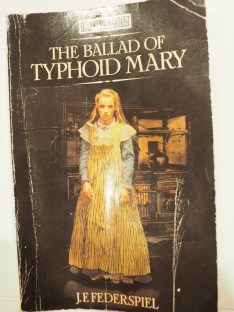
I found this gem of a book in a little second hand bookshop in Glasgow a couple of years ago: J.F. Federspiel’s reimagining of the life of Mary Mallon in ‘The Ballad of Typhoid Mary’. What a nickname to be remembered by! – but unfortunately for Mary and all of her unintentional victims, a very accurate one.

Federspiel, with a bit of poetic license, introduces us to Mary, or Maria Caduff as he imagines her to be, a young Swiss immigrant on the ‘Leibnitz’ ship which docks at New York in 1868, bringing a spectacle of horrors with it as 108 of its 544 immigrants have succumbed to an epidemic. “Plague on board!” holler the newsboys, as Maria is taken in by Dr Dorfheimer, and starts to cook and clean for him. Unbeknownst to Dorfheimer, and to Maria herself at this time, she carries the deadly illness which decimated the Leibnitz passengers, but is herself immune.

This extraordinary story chronicles Maria’s life as she adopts a new identity of an Irish immigrant, Mary Mallon, travels through various jobs in New York “like an angel of death”,  doing the thing she loves most of all – cooking – and almost invariably passing on the infectious germs of Salmonella typhi, or typhoid fever, whilst doing so. Even to her contemporaries, the legend of Typhoid Mary becomes one of nightmares. “Typhoid Mary … a grim-looking cook with gnashing teeth and saliva dripping from her mouth into a steaming, poison-green cauldron.” How uncomplimentary!

Typhoid Mary.jpg

Federspiel’s story jumps between a narrative of Mary’s life, and the soliloquy of the paediatrician Dr Howard Rageet presumably writing a biography of Mary in the 1980s. Although this feels to me to be a clumsy method of storytelling, this approach does allow Federspiel to comment retrospectively on the medical facts around typhoid, as well as his semi-fictional historical narrative, so it does add useful perspective to the story.

Lorem Ipsum (2016) Mallon-Mary 01.jpg at Wikimedia Commons

How accurate are the depictions of typhoid? Kudos to Federspiel, he’s done his homework and his descriptions are pretty spot on! Almost without fail, all of Mary’s victims fall ill within 1 to 3 weeks of her arrival into their service, and they tend to suffer from the typical symptoms of typhoid including a high fever, nausea, delirium and voluminous diarrhoea. The death rates are fairly high, up around 10-20% as would have been expected in the pre-antibiotic days. Dr Rageet notes the transmission of typhoid is water and faeces-borne.

All good things must come to an end….before too long the public health authorities get wind of Mary’s accidental secret ingredient, arrest her and isolate her in prison. They prove she is a typhoid carrier, someone who carries the bacterium without themselves becoming sick, but who can pass this on to susceptible people, by finding the typhoid bacteria in samples of her urine and faeces – as per Mary’s medical report below.
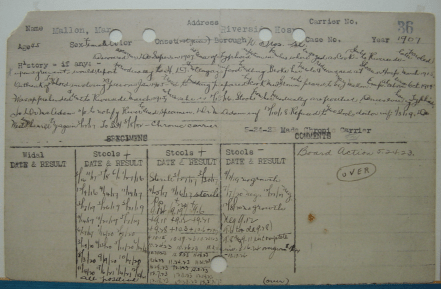
Stool chart Mary Mallon

Jtamad (2015) MaryMallon.stoolreport.1907.png available at Wikimedia Commons

After much legal uproar, Mary is finally freed and agrees not to cook for anyone else. She doesn’t stick to this promise, unfortunately, and causes an outbreak in a large women’s hospital which gets her noticed again, and this time she is isolated until her death from complications of a stroke more than twenty years later. Poor old Mary!

All in all, this is an intriguing and enjoyable little read which chronicles a fascinating era in history, at a time just before the advent of antibiotics which would have dramatically changed the outcome. Makes me glad to live in a time where health and safety is now known to be so crucial in preventing disease transmission, and where the Typhoid Marys of today can receive treatment to ensure they don’t spread the disease!

Have you heard of Typhoid Mary, or even experienced typhoid yourself! Share your comments and send your questions to Infectious Reads!
The Microbe behind the Mask

Welcome back!

After a bit of an interlude, the blog is back, ready to delve into the murky and fascinating world of epidemics, told through the words of poets and writers. Just when you think that the world of microbes has caused enough destruction to leave little to the imagination, here comes a particularly dark little story of a fictional disease, as told by the master of horror, Edgar Allan Poe…

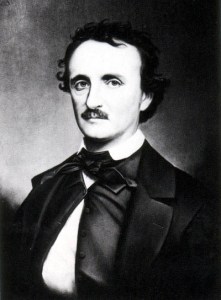
Edgar_Allan_Poe_portrait_B

Oscar Halling’s portrait of Edgar Allan Poe, late 1860s. Image in public domain at Wikimedia Commons [link]

‘The Masque of the Red Death’ narrates the grisly events that occur during the fictional reign of Prince Prospero. The story plunges us straight into a vivid description of the Red Death, a longstanding epidemic with high fatality rates and a gruesome effect on its victims, causing profuse bleeding, pain, seizures – and a mercifully rapid death.

“Blood was its Avatar and its seal”. The death toll is staggering: half the population have already succumbed by the beginning of Poe’s story.

Prince Prospero, who appears indifferent to the plight of his subjects, decides to “bid defiance to the contagion”, and with ample provisions, shuts himself and a thousand friends away in one of his sumptuous abbeys, to dance and merry-make in security from the Red Death. This seclusion continues successfully for the next six months, whilst those without fare poorly.

The Masquerade

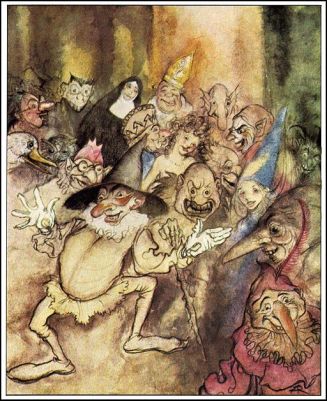
A motley collection of masked guests, as illustrated by Arthur Rackham in “Poe’s Tales of Mystery and Imagination (1935). Image in public domain at Wikimedia Commons [link]

A masquerade! Prince Prospero certainly knows how to entertain, and throws an extravagant masked ball for his guests. The rooms are decorated vividly, as we enter a realm of metaphors. With some bizarre interior design, Prospero makes his tapestries and Gothic windows colour-coordinate; six rooms in blue, purple, green, orange, white and violet; a seventh of deep scarlet windows and black velvet walls, illuminated with fire. Ominous and wild, the revellers shy away from entering this last room: but each hour, stand transfixed in horror by the disconcerting toll of a pendulum clock from deep within the seventh chamber.

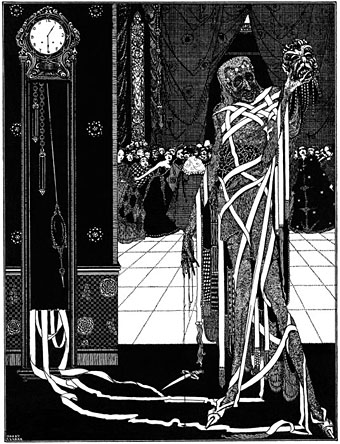
At the twelfth hour, as the clock chimes heavily and the waltzing falters, a masked figure fades into notice; a masked figure of unparalleled distaste, costumed as the Red Death itself. Tall, gaunt, corpse-like, phantasmagorical, daubed with blood, “besprinkled with the scarlet horror”: a vision of nightmare indeed!

The Red Death

“The dagger dropped gleaming upon the sable carpet” by Harry Clarke (1919). Image in public domain at Wikimedia Commons [link]

The encounter, suffice to say, with all its foreboding, ends badly, and rapidly, for Prince Prospero and his courtiers, who believed themselves safe against the Red Death. “One by one dropped the revellers in the blood-bedewed halls of their revel, and died each in the despairing posture of his fall… And Darkness and Decay and the Red Death held illimitable dominion over all.”

Well! Edgar Allen Poe isn’t renowned for his happy endings, so this gruesome end is probably to be expected. Just as well this is only a fictional disease….or is it?

In the wake of the recent devastating Ebola pandemics of Sierra Leone, Liberia and Guinea-Bissau, the parallels of the Red Death with one of the known haemorrhagic fevers can’t help but spring to mind. These haemorrhagic fevers include Ebola and Marburg fever, and have similar symptoms of fever, muscle pain, headache, nausea, then diarrhoea, vomiting and in some cases significant bleeding (WHO 2014).

As I suspected, I’m not the first to notice this: in fact, a published article in the journal ‘Emerging Infectious Diseases’ by Vora & Ramanan in 2002 explored this very question! The article is well worth a read and is available here. The authors postulate the mode of transmission of the Red Death (person-to-person, and possible aerosol inhalation) and the potential for either a very long incubation period for the Red Death microbe, or a new exposure to the abbey by an unspecified route.

So could Poe have modelled the Red Death after a known disease, or did he imagine up all of the gruesome features of the whole epidemic? Well, Poe probably have reasonable knowledge of yellow fever, a different type of haemorrhagic fever, – but one which causes liver failure and jaundice, neither of which are evident with the Red Death. Poe was also well aware of tuberculosis, which can manifest with coughing up blood from the lungs: both his mother and wife died of the disease.  Since Ebola, Marbug virus and another counterpart, Crimean-Congo haemorrhagic virus, all emerged in the 1900s, after Poe’s death, the parallel with the Red Death must be purely coincidental.

Whatever Poe’s experience of contemporary diseases, however, his description of the Red Death is vivid, realistic, and perhaps a warning of how complacency and seclusion in the interests of self-preservation are no match for a virulent pestilence with no respect for social contexts and hierarchy! Perhaps then, we should interpret Poe’s tale as a graphic and timely warning – public health initiatives, take note!

References:

Vora, S.K. & Ramanan, S.V. (2002) Ebola-Poe: A Modern-Day Parallel of the Red Death? CDC Emerging Infectious Diseases 8(12):December 2002

World Health Organisation (2014) Ebola Virus Disease: background and summary. Published 3 April 2014, available at: http://www.who.int/csr/don/2014_04_ebola/en/